
It’s a cliché, but there is nothing more rewarding than publishing a book. The sweat and tears that go into the process are more than compensated for by holding the end product in your hand and by the space and the liberty that the format provides. Specifically, I have experienced publishing books as more stimulating than surviving peer reviews in journals.
That said, a professional publisher and a trusting editor are crucial to turn the project into a success. I was lucky to have had both (even twice) working with Cambridge University Press and its wonderful executive editors Finola O’Sullivan and Marianne Nield.
Below you will find the two books, a monograph and an edited volume, that I have published. There also is an overview of the chapters that I have written for various volumes over the years, with many being open access.
Demanding Rights: Europe’s Supranational Courts and the Dilemma of Migrant Vulnerability
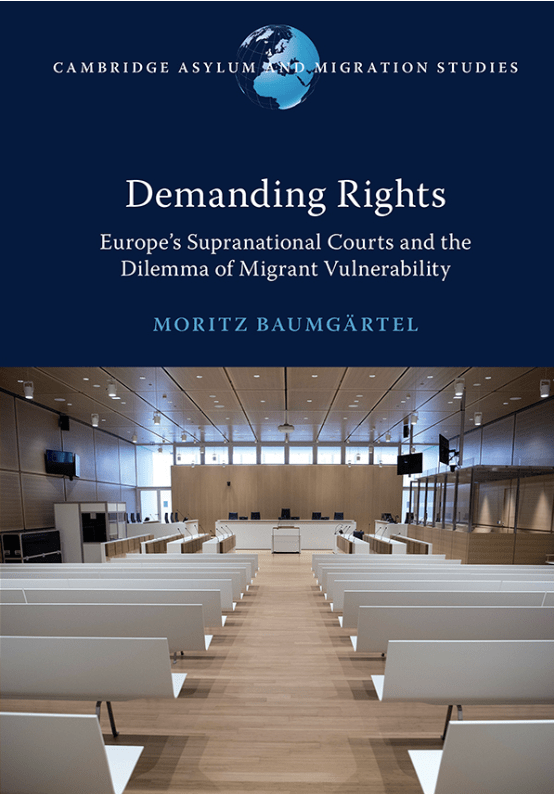
My first monograph is based on the Ph.D. thesis that I defended at Université Libre de Bruxelles at the end of 2016. The second part of the book adds three new chapters to this thesis discussing specifically how to improve the trailing European human rights system. The monograph was published within the Cambridge Asylum and Migration Studies series.
Publication date: May 2019
Publisher: Cambridge University Press
ISBN: 9781108677837
Pages: 188
See book description
While nominally protected across Europe, the human rights of vulnerable migrants often fail to deliver their promised benefits in practice. This socio-legal study explores both the concrete expressions and possible causes of this persistent deficit. For this purpose, it presents an innovative multifaceted evaluation of selected judgments of the European Court of Human Rights and the Court of Justice of the EU pertaining to such complex questions as the protection of persons fleeing from indiscriminate violence, homosexual asylum seekers, the Dublin Regulation, and the externalisation of border control. Highlighting the demanding character of migrant rights, the book also discusses some steps that could be taken to improve the effectiveness of Europe’s supranational human rights system including changes in judicial and litigation practice as well as a reconceptualization of human rights as existential commitments.
See endorsements
‘With a rigorous methodology and laser-precise analysis, Baumgärtel shows the potential – if adequately prompted by rights defenders – for the European judiciary to steer migration policies towards a better protection of the human rights of migrants, despite the increasing nationalist populist pressure towards tighter ‘securitisation’ of the borders.’
– François Crépeau (McGill University)
‘Zooming in on one of the most contentious fields of contemporary human rights struggles – migrant rights – this excellent monograph investigates what can be expected of European supranational jurisdictions. The study of the impact and/or effectiveness of strategies is a crucial yet still underdeveloped aspect of human rights work. Baumgärtel has developed a method that allows him to assess the results of the work of the Strasbourg and Luxemburg courts. Admirably, this author resists the temptation of surfing on the wave of human rights skepticism. Instead, he chooses constructive engagement with human rights theory as well as with strategies of courts and litigators, aimed at optimizing effectiveness.’
– Eva Brems (Ghent University)
‘[T]his book is highly recommended. The strength of Baumgärtel’s work lies in the clarity of his arguments despite the complexity of the subject; his clear guidance on how to unpack human rights adjudication; his convincing and novel approach of using a vast array of sociolegal sources, ranging from the empirical methods of case assessment to qualitative interviews; and his thorough and occasionally provocative assessment of prevailing shortcomings regarding the realization of vulnerable migrants’ rights, combined with numerous constructive proposals to advance these rights. These qualities make Demanding Rights a valuable contribution to theoretical critical human rights scholarship and to the work of human rights defenders alike.’
– Lena Riemer (Full review in the International Journal of Constitutional Law)
‘Moritz Baumgärtel’s book … offers remarkably clear insight into the impact of the European Court of Human Rights (ECtHR) and the Court of Justice of the European Union (CJEU) jurisprudence on the actual protection of the rights of vulnerable migrants … Most importantly, he has included in the discussion the various stakeholders – courts, attorneys, state officials and, of course, migrants themselves. Adjusting remarkably well the theories of effectiveness to explain the perplexing and multi-dimensional causes and effects of European courts adjudication, Baumgärtel has created a book that is a valuable addition to the reading shelf both of a legal practitioner and a migrant rights advocate, introducing, simultaneously, a fresh set of ideas which could engage other researchers in fruitful discourse.’
– Dimitra Fragkou (Full review in the Human Rights Law Review)
See related blog posts
“COVID-19 and the Vulnerability of Migrants” (Cambridge Blog, 29 June 2020)
“The Dilemma of Migrant Rights” (Cambridge Blog, 9 July 2019)
“High Risk, High Reward: Taking the Question of Italy’s Involvement in Libyan ‘Pullback’ Policies to the European Court of Human Rights” (EJIL Talk!, 14 May 2018)
Theorizing Local Migration Law and Governance

My second book, this time an volume that I co-edited with my colleague Sara Miellet. This book project started with two panels at the 2019 Law and Society Association (LSA) Conference in Washington, D.C. Sara and I worked on it within the framework of the Cities of Refuge research project.
The volume is fully open access via Cambridge Core.
Publication date: September 2022
Publisher: Cambridge University Press
ISBN: 9781009047661
Pages: 345
See book description
In many regions around the world, the governance of migration increasingly involves local authorities and actors. This edited volume introduces theoretical contributions that, departing from the ‘local turn’ in migration studies, highlight the distinct role that legal processes, debates, and instruments play in driving this development. Drawing on historical and contemporary case studies, it demonstrates how paying closer analytical attention to legal questions reveals the inherent tensions and contradictions of migration governance. By investigating socio-legal phenomena such as sanctuary jurisdictions, it further explores how the law structures ongoing processes of (re)scaling in this domain. Beyond offering conceptual and empirical discussions of local migration governance, this volume also directly confronts the pressing normative questions that follow from the growing involvement of local authorities and actors.
See endorsements
‘In a time in which the local governance of immigration is hotly debated at an international level, this book provides an excellent analysis of local experiences and intellectual debates, comparing different countries on both sides of the Atlantic and crossing several disciplines, ranging from political science to sociology, from law to critical geography. I highly recommend this book to every scholar willing to understand and deepen the actual governance of immigration in a multilevel political setting.’
– Maurizio Ambrosini (University of Milan)
‘This collection is a timely and important series of global reflections on the legal negotiations, tensions, and ambivalences that underpin migration governance. Conceptually innovative and empirically rich, it opens new avenues for thinking about the intersections of law, governance, and contestation that are shaping a “local turn” in migration scholarship.’
– Jonathan Darling (Durham University)
‘This ground-breaking work provides the much-needed theoretical reflection on the role of the law in one of the key contemporary trends in migration governance: the rise of local authorities. Well-researched, well-written and truly thought-provoking, it is a must-read for all who work in this field – scholars and practitioners alike.’
– Barbara M. Oomen (Utrecht University)
Book chapters
“Cities”
Author: Moritz Baumgärtel
Volume: Elgar Concise Encyclopedia of Migration and Asylum Law, pp. 43-49
Editor: Vincent Chetail
Publisher: Edward Elgar, 2025
See abstract
Cities and their local governments have come to play a central role in the governance of migration. Following their initial involvement in the reception, accommodation and integration of newcomers at the domestic level, they nowadays also seek to shape the outlook of migration law, including at the international level. As a result, migration studies have likewise taken a ‘local turn’ to provide a more accurate account of the new reality of ‘multi-level governance’. This entry offers an overview of important legal aspects related to this recent advent of cities in the migration. For this purpose, it focuses on the origins and manifestations of their growing involvement and the challenges that these create for international and domestic legal systems as well as scholars of migration and law.
“The European Court of Human Rights, Upending Migrant Rights: On Marie-Bénédicte Dembour’s When Humans Become Migrants”
Author: Moritz Baumgärtel
Volume: Leading Works in Law and Anthropology, pp. 90-111
Editors: Alice Margaria and Larissa Vetters
Publisher: Routledge, 2024 (Open access via Utrecht University Repository)
See abstract
Marie-Bénédicte Dembour’s When Humans Become Migrants: Study of the European Court of Human Rights with an Inter-American Counterpoint (2015) examines the origins, evolution, and effects of the migration case law of the European Court of Human Rights and contends that it systematically defers to state interests to the detriment of migrant applicants. This chapter discusses the book’s relevance as a true junction in the critical study of migrant rights in Europe and a demonstration of the analytical power of in-depth, anthropologically inspired, and qualitative evaluations of rulings by international human rights courts. Special attention is paid to the historical and anthropologically informed appraisal of the ECtHR’s case law, Dembour’s concept of the ‘Strasbourg reversal’, and her use of the Inter-American Court of Human Rights as a rights-affirming counterpoint to the European Court. The chapter also situates When Humans Become Migrants in the broader contexts of the crisis paradigm that continues to dominate Europe’s approach to migration, Hannah Arendt’s fundamental critique of the lack of a right to have rights, and scholarship on the proliferation and variable and contingent authority of international courts.
“The ‘Safe Harbor’ of Berlin: Socio-legal Constellations and Complex Strategies of Divergence”
Authors: Moritz Baumgärtel and Franziska Pett
Volume: Theorizing Local Migration Law and Governance, pp. 87-111
Editors: Moritz Baumgärtel and Sara Miellet
Publisher: Cambridge University Press, 2022 (Open access via Cambridge Core)
See abstract
This chapter analyzes the ‘strategies of divergence’ adopted by the City of Berlin following the widespread mobilization in Germany calling for high sea rescues. With its legal status as a city-state, Berlin is generally seen as having played a supportive role when proclaiming itself a ‘safe harbor’. By contrast, this chapter makes three observations to draw attention to the more complex reality shaping strategies of divergence from restrictive national policies. First, local authorities may pursue multiple strategies simultaneously, with the example of Berlin highlighting their interconnection and the extent to which competencies determine a given course of action. Second, the approach taken by municipal actors is shaped fundamentally by its interaction with civil society. Rather than only narrowing discretionary spaces, such movements may widen them by offering local authorities the ability to position themselves strategically. Finally, the coexistence of distinct socio-legal constellations confronting a city necessarily complicates normative assessments of the ‘local turn’ in migration policy. Particularly in the case of legally resourceful localities like Berlin, municipal approaches may seem ambiguous and contradictory, while being pragmatic and strategic from the perspective of the local authorities. This raises questions regarding the reasons behind, and viability of local strategies of divergence.
“Introduction: Theorizing Local Migration Law and Governance”
Authors: Moritz Baumgärtel and Sara Miellet
Volume: Theorizing Local Migration Law and Governance, pp. 1-30
Editors: Moritz Baumgärtel and Sara Miellet
Publisher: Cambridge University Press, 2022 (Open access via Cambridge Core)
See abstract
Serving as an introduction to the volume, this chapter begins by setting out some of the recent dynamics in migration governance, including devolution, recentralization and the increasingly proactive stance taken by local authorities in this domain. This, in turn, brought about a “local turn” in migration scholarship. Although generally transdisciplinary and integrative of various methodologies including quantitative, historical, and ethnographic studies, scholarship on the “local turn” has failed to consider legal perspectives where it rescales analyses of migrant reception and inclusion away from the state. This chapter interrogates the relegation of the law to mere context or epiphenomenon and discusses the analytical implications of this curious demotion of a central dimension of governance. In the second instance, this contribution introduces the three themes of this volume as potential launchpads for the further theorization of migration governance based on analyses of legal debates, processes and principles. For this purpose, it offers a brief account of the already existing relevant literature that can inform empirical, conceptual and normative engagements with law as migration governance. The overview of the three themes is, in each case, complemented by a short description of the contribution that the various chapters make to their discussion.
“Dispute Settlement”
Author: Moritz Baumgärtel
Volume: Research Handbook on International Law and Cities, pp. 147-157
Editors: Helmut Philipp Aust, Janne Nijman and Miha Marcenko
Publisher: Edward Elgar, 2021 (Open access via Utrecht University Repository)
See abstract
The settlement of disputes is commonly seen as one of the principal function of modern international law. This chapter offers a structured overview of the analytical issues relating to the involvement of cities in international dispute settlement, which has itself taken a functionalist turn in recent decades. It is observed, first, that local authorities cannot bring claims against their own government. The focus then shifts to the possibilities, rare and largely unused, for them to become ‘directly’ involved in dispute settlement in certain domains. The subsequent section examines the role of local authorities in proceedings under EU and domestic law in cases raising questions of international law. Finally, the chapter addresses more commonly known yet likewise under-researched instances of ‘indirect’ participation of local authorities. The conclusion discusses what cities’ engagement with international dispute settlement tells us about international law as a field of practice and academic discipline more generally.
“Local Authorities, Poverty and the Implementation of Human Rights Norms”
Author: Moritz Baumgärtel
Volume: Research Handbook on Human Rights and Poverty, pp. 279-294
Editors: Morten Kjaerum, Martha Davis and Amanda Lyons
Publisher: Edward Elgar, 2021 (Open access via Utrecht University Repository)
See abstract
Cities, towns, and their local authorities are increasingly regarded as central actors in the realization of human rights norms. This chapter discusses the role that they (can) play in implementing and possibly shaping human rights norms that address challenges arising from poverty. It also considers to what extent human rights, as law and discourse, provide necessary or even useful frameworks for local governments active in this domain. The chapter begins by recounting the responsibilities that local authorities hold in terms of international human rights law. It subsequently presents some of the most prominent examples of international actors harnessing the capacities of local authorities to reduce poverty. Finally, it discusses a number of examples of relevant autonomous efforts by local governments. Seeking to provide a nuanced account of these developments, it does so by contrasting approaches that vary in their reliance on international human rights law and discourse.
“Accelerating Cities, Constitutional Brakes? Local Authorities Between Global Challenges and Domestic Law”
Authors: Barbara Oomen, Moritz Baumgärtel and Elif Durmuş
Volume: European Yearbook of Constitutional Law 2020, pp. 249-272
Editors: Ernst Hirsch Ballin, Gerhard van der Schyff, Maarten Stremler and Maartje De Visser
Publisher: T.M.C. Asser Press, 2021 (Open access via Utrecht University Repository)
See abstract
Increasingly, local authorities around the world invoke international law to tackle global challenges autonomously while distancing themselves from national laws and policies, sometimes stimulated by international authorities. This chapter addresses the relevance of national constitutional arrangements for the way in which the resulting conflicts are, or are not, resolved. More specifically, how do domestic courts respond to ‘accelerating cities’ invoking international law as they oppose policies of the national government? Discussing cases from Germany, Turkey, France, the Netherlands and Spain, we offer an initial exploration of how such cases have the potential to challenge the constitutional order in federal and unitary states alike. At the same time, ‘accelerating cities’ are confronted with ‘constitutional brakes’—barriers in national constitutional and administrative rules. Our analysis suggests that national courts may permit harmless symbolic acts, but step down, or even create a ‘backlash’ in the case of more consequential actions. Given the potential in local engagement with international law, and the rise of the phenomenon, it is urgent to set up systematic and detailed investigations and comparisons of the dynamics of local government law in different countries and how they are shaped by an invocation of international law in general, and human rights law in particular.
“‘Part of the Game’: Government Strategies against European Litigation Concerning Migrant Rights”
Author: Moritz Baumgärtel
Volume: The Changing Practices of International Law, pp. 103-128
Editors: Thomas Gammeltoft-Hansen and Tanja Aalberts
Publisher: Cambridge University Press, 2018 (Open access via Utrecht University Repository)
See abstract
The human rights situation of migrants and asylum seekers represents one of the most difficult and pressing issues before the European Court of Human Rights and the Court of Justice of the EU. Growing migration flows and the ascendance of a right-wing political climate have created a volatile situation in which governments enact legally questionable policies, which in turn are increasingly being challenged before the two European courts. Looking at recent cases, this chapter explores how governments maximize their ‘sovereign manoeuvrability’ when confronted with European-level litigation. Based on original research including interviews with persons involved in the relevant cases, it describes four different strategies of ‘managing’ and containing the impact of such rulings: legal argumentation about the scope of the relevant instruments, policy implications and procedural requirements; ‘anticipatory measures’ aiming to strike out cases or to contain public reactions to adverse rulings; ‘peer mobilisation’ exerting collective pressure on the courts; and post-judgment positioning vis-à-vis the judgment or the court in question. The chapter highlights the ambiguity of even seemingly far-reaching rulings, as the changing practices of international law require more differentiated evaluations even of the influence of strong and assertive international judicial bodies such as the two European courts.
“Établir un droit juste de la migration”
Authors: Sarah Ganty and Moritz Baumgärtel
Volume: Les défis du droit global, pp. 79-113
Editors: Benoît Frydman and Caroline Bricteux
Publisher: Bruylant, 2018
“Human Rights Cities”
Authors: Barbara Oomen and Moritz Baumgärtel
Volume: The Sage Handbook of Human Rights (vol. 2), 709-729
Editors: Mark Gibney and Anja Mihr
Publisher: Sage, 2014
See abstract
A striking development in human rights implementation over the past decades has been the rise of human rights cities. This contribution defines a human rights city as an urban entity or local government that explicitly bases its policies, or some of them, on human rights as laid down in international treaties, and thus distinguishes itself from other local authorities. It theorizes the background to this process and offers a typology of human rights cities. Some initiatives, for instance, are more top-down and others more bottom-up, and some cities emphasize a specific subset of rights, whilst others base their policies on human rights in general. The typology is followed by a brief discussion of the actual legal obligations that cities have in the field of human rights implementation. The main reasons for cities to engage with human rights are, however, more social and political than purely legal. This sociopolitical background is illustrated in referring to the city of Utrecht, in the Netherlands. Finally, the contribution offers some general conclusions on the potential and pitfalls of reference to international human rights in formulating urban policies.
“A Long Way Down: European Expectations, Domestic Barriers and the ‘Obama Effect’ in International Climate Change Policy”
Author: Moritz Baumgärtel
Volume: Obama, US Politics, and Transatlantic Relations: Change or Continuity
Editor: Giles Scott-Smith
Publisher: Peter Lang, 2012
 Moritz Baumgärtel